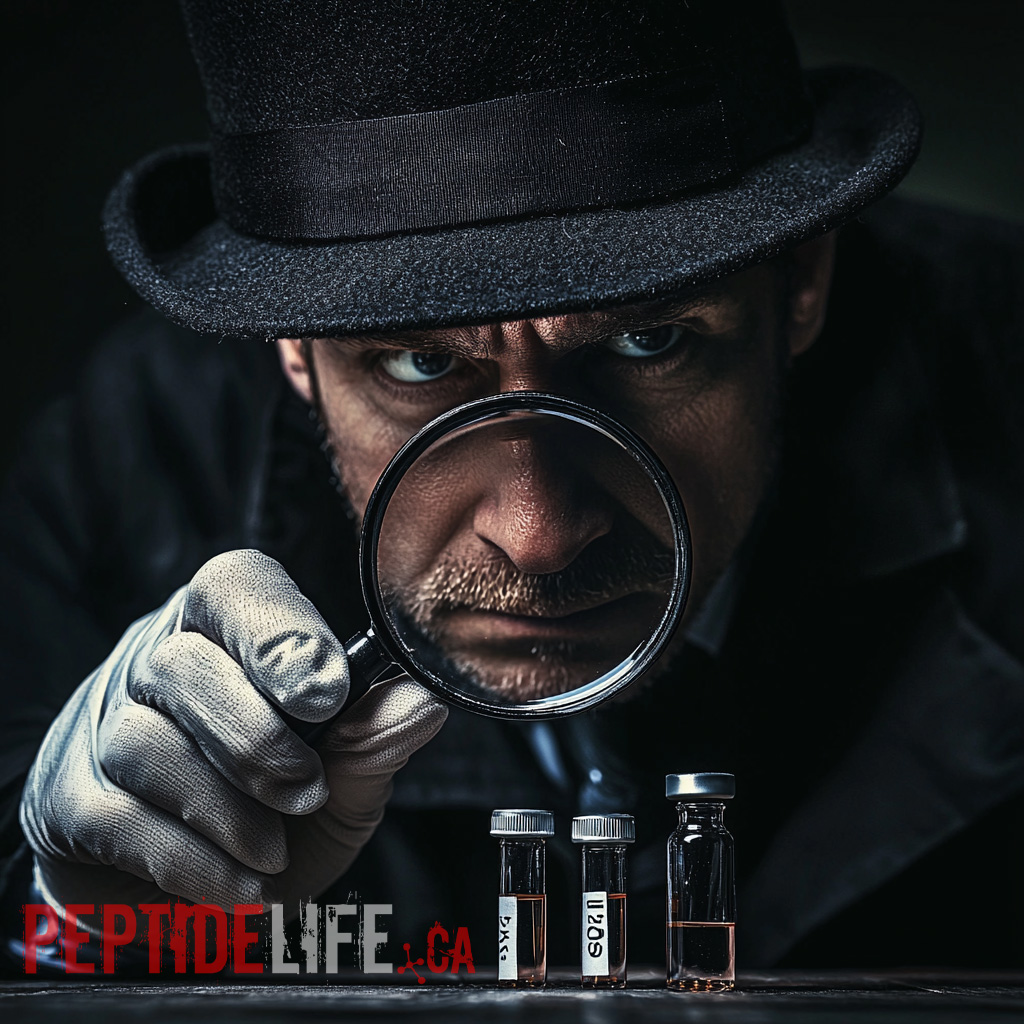
As peptides become more popular, fake websites and clone suppliers are becoming a bigger problem.
Some websites copy legitimate brands, steal product images, reuse lab report screenshots, fake reviews, and create lookalike domains that are only one small detail away from the real thing. To a new buyer, these websites can look professional enough to trust.
That is the problem.
In the peptide space, a clean website does not automatically mean a legitimate supplier. A nice label does not prove quality. A lab report screenshot does not always prove testing. And a familiar-looking product photo does not mean the company actually owns or stocks that product.
This guide breaks down the most important warning signs to check before ordering from a peptide website, especially if the site looks like a clone, uses copied images, or seems too close to another brand.
This article is for educational purposes only and is not medical advice. Peptides, especially injectable products, can carry serious health and legal risks depending on where you live and how they are used.
Why Fake Peptide Websites Are Becoming More Common
Peptides have moved from niche bodybuilding forums into mainstream wellness, anti-aging, fat loss, injury recovery, sleep, skin care, and performance conversations. That popularity creates opportunity. Unfortunately, it also creates a perfect environment for fake websites.
Peptides are expensive. Many buyers are new. The legal status can be confusing, especially when it comes to understanding how peptides are regulated in Canada. Some products are sold for “research use only.” Many payment processors restrict these categories. And buyers often rely heavily on branding, product photos, reviews, and lab reports to decide who to trust.
Clone websites take advantage of that confusion.
A fake peptide website may not need to invent anything from scratch. It can copy another supplier’s layout, steal product photos, scrape descriptions, reuse branding, and create a domain name that looks close enough to trick people.
That is why buyers need to slow down and verify the source before placing an order.
1. Check the Domain Name Carefully
One of the easiest ways fake peptide websites trick buyers is with a lookalike domain.
A clone site may use:
- A hyphenated version of the real brand name
- A different domain ending
- A plural or singular variation
- A misspelled word
- An added word like “official,” “store,” “canada,” or “shop”
- A domain that looks almost identical at a quick glance
For example, if a legitimate brand uses one official domain, a clone might create a similar-looking version and hope people do not notice.
Before ordering, look closely at the full website address. Do not rely only on the logo, colors, or product photos. Those can be copied.
A legitimate brand should make its official website clear. If you found the site through a random search result, ad, comment, Telegram message, or social media post, verify that you are actually on the correct domain.
2. Be Suspicious of Stolen Product Images
Stolen images are one of the biggest warning signs of a clone peptide website.
A fake supplier may copy:
- Product vial photos
- Homepage banners
- Category images
- Label designs
- Lifestyle graphics
- Lab report screenshots
- Before-and-after style images
- Blog images or educational diagrams
This matters because product images are often used to create trust. A buyer sees professional photos and assumes the company must be real. But if those images were stolen from another supplier, the website may not have the product, the testing, or the reputation it is trying to borrow.
If the same product image appears on multiple unrelated peptide websites, slow down. That does not automatically prove which website is legitimate, but it does mean the buyer should verify further.
A good habit is to reverse-image search important product photos, banners, or lab report screenshots. If the same images show up across several unrelated websites, that is a warning sign.
3. Watch for Copied Product Descriptions
Clone websites often copy more than images. They may also copy product descriptions, blog content, dosage disclaimers, FAQs, shipping policies, and even spelling mistakes.
A copied description is not always proof of fraud, but it is a bad sign when combined with other issues.
Look for patterns like:
- The same product descriptions appearing word-for-word on different websites
- FAQ pages that mention another brand by accident
- Policy pages that feel generic or copied
- Product names that match another supplier exactly
- Broken internal links
- Inconsistent wording from page to page
A real supplier should have consistent branding, clear product information, and policies that match its own business.
4. Look Closely at Lab Reports and COAs
Third-party testing can be useful, but only if the report is real, readable, current, and actually matches the product being sold.
A fake or weak lab report may have:
- No batch number
- No matching product name
- No testing date
- No lab name
- A blurry screenshot instead of a clear report
- Cropped sections
- Missing purity or quantity details
- The same report reused across multiple products
- A report that does not match the vial label
- A report that looks edited or incomplete
Some websites display lab reports because they know buyers look for them. But a report on a product page is not automatically proof of quality. The report should match the specific product and batch. It should be clear enough to read. It should not look like a random screenshot copied from another website.
If a supplier claims to have third-party testing but only shows vague graphics, cropped screenshots, or generic “tested” badges, treat that as a reason to investigate further. If you’re unsure what the numbers and testing details mean, see my guide on how to read peptide lab reports and third-party testing.
5. Be Careful With Fake Reviews
Reviews can be helpful, but they are also easy to fake.
Common fake review patterns include:
- Every review is five stars
- Reviews are posted in large batches on the same day
- Reviews use generic wording
- Reviews sound overly polished or repetitive
- Reviews mention benefits that sound exaggerated
- The same review appears on more than one website
- There is no indication that reviews are from real customers
- The website has many reviews despite appearing to be new
A trustworthy review section usually has natural variation. Real customers write differently. Some mention shipping. Some mention packaging. Some ask questions. Some leave short comments. Some are not perfectly written.
If every review sounds like marketing copy, be cautious.
6. Do Not Judge by Payment Method Alone
Payment methods in the peptide space can be complicated.
Crypto, e-transfer, alternate payment names, or non-traditional payment systems are not automatically proof that a website is fake. Many companies in restricted or grey-market categories have trouble using mainstream processors, even when they are trying to operate consistently.
The real issue is not the payment method alone. The real issue is when limited payment protection is combined with other red flags, such as:
- A lookalike domain
- Stolen product images
- No clear contact information
- No believable testing
- No order support
- No history or reputation
- No clear policies
- Pressure to pay quickly
- A seller who disappears after payment
- A website that copies another brand
Because these payment methods may offer less buyer protection, the supplier needs to earn more trust before you send money.
In other words, crypto or e-transfer does not automatically mean scam. But if the website is anonymous, copied, recently created, full of stolen images, and impossible to verify, the risk becomes much higher.
7. Be Wary of Prices That Are Too Low
Everyone wants a deal, but extremely low peptide pricing can be a warning sign.
Cheap pricing may mean:
- No third-party testing
- Underdosed product
- Old stock
- Poor handling
- Relabeled product
- A bait-and-switch offer
- A fake store collecting payments without shipping
That does not mean the most expensive supplier is always the best. Price alone does not prove quality either way.
A better question is:
Does the price make sense when compared with testing, reputation, support, consistency, shipping practices, and product transparency? If a website is dramatically cheaper than everyone else and also has weak testing, copied images, fake-looking reviews, and no clear identity, that is not a bargain. That is a risk.
8. Check for Real Contact and Support
A legitimate supplier should not be impossible to contact.
Before ordering, check whether the website has:
- A working contact page
- A support email
- Clear shipping information
- Clear refund or reship policies
- Reasonable response times
- Consistent branding across emails and website pages
- No obvious copy-paste errors from another company
A fake website may look fine until something goes wrong. Then buyers realize there is no support, no accountability, and no way to resolve the issue. If the only contact option is a random social media account, anonymous chat handle, or rushed payment instruction, that should make you pause.
9. Look for Signs the Website Was Rushed
Clone sites are often built quickly. They may look polished at first glance, but small mistakes give them away.
Watch for:
- Broken pages
- Placeholder text
- Missing policy pages
- Product categories with no products
- Inconsistent label designs
- Spelling errors in brand names
- Different logos across the site
- Images with mismatched backgrounds
- Pages that mention another company
- Blog posts that feel scraped or AI-generated
- Social links that go nowhere
A few small typos do not automatically mean scam. But a pattern of rushed, copied, or inconsistent content is a warning sign.
10. Be Careful With “Official” Claims
Some clone websites try to look more legitimate by using words like:
- Official
- Verified
- Trusted
- Premium
- Pharmaceutical grade
- Lab tested
- Doctor recommended
- Canada approved
- FDA approved
- Medical grade
These claims need proof.
In the peptide space, terms like “pharmaceutical grade” or “medical grade” are often used loosely in marketing. A website can say almost anything on a product page.
Look for evidence, not buzzwords.
If a supplier claims testing, where is the report? If it claims official status, official according to who? If it claims approval, what approval exactly? If it claims to be connected to a known brand, does the known brand confirm that?
Marketing words are easy to copy. Verification matters more.
11. Check the Website’s History
A brand-new domain is not automatically fake, but it should be judged more carefully. Many clone sites appear suddenly, run ads or social posts, collect orders, and disappear. Checking the age and history of a domain can help you understand whether the website has been around for years or appeared recently.
One simple way to check is by using a WHOIS lookup tool. A WHOIS search can often show when the domain was registered, when it was last updated, and which registrar is being used. If a peptide website claims to be an established supplier but the domain was only registered recently, that is a reason to slow down and verify further.
Things to check:
- When the domain was registered
- Whether the website has older archived pages
- Whether the brand has a consistent history
- Whether the same domain has been used for unrelated content before
- Whether the company has a presence outside its own website
A newer website can still be legitimate, but a new domain using copied images, copied descriptions, fake reviews, weak lab reports, and a lookalike brand name is a major warning sign.
12. Search the Brand Name With Scam Terms
Before ordering from a peptide website, search the brand name with terms like:
- scam
- reviews
- fake
- clone
- complaints
- lab test
- shipping
- not received
- stolen images
Do not believe everything you read online, but look for patterns.
One angry comment does not prove a company is bad. But repeated reports of missing orders, copied images, bad support, fake testing, or lookalike domains should not be ignored. Also be careful with fake positive discussion. Some suppliers or affiliates may create staged posts to look more trusted than they are.
13. Use a Buyer Safety Checklist Before Ordering
Before placing an order, ask these questions:
- Am I on the official domain?
- Does the domain look like a clone or misspelling?
- Is the domain newly registered?
- Are the product images original?
- Do the images appear on unrelated websites?
- Are the lab reports clear and batch-specific?
- Do the reports match the products being sold?
- Are the reviews believable?
- Are the policies clear?
- Is there a real contact method?
- Does the website have a consistent history?
- Are the prices realistic?
- Does the branding look copied?
- Are there broken pages or rushed content?
- Are payment instructions consistent and professional?
- Can I find independent discussion of the supplier?
- Does anything feel pressured, hidden, or too good to be true?
You do not need perfection on every point, but the more red flags you find, the more careful you should be.
14. Why Stolen Images Hurt Buyers and Real Brands
Stolen images are not just a copyright issue. They create real buyer confusion.
When a clone website steals product photos or banners from a legitimate supplier, buyers may think they are ordering from the original source. If the fake site takes payment, ships poor-quality products, or never ships at all, the real brand may get blamed.
This also makes it harder for buyers to know which supplier is actually trustworthy.
That is why image theft, copied branding, and clone domains matter. They are not just annoying business problems. They are warning signs that a website may be trying to borrow trust it has not earned.
15. What to Do If You Find a Clone Peptide Website
If you believe a website is copying another brand or using stolen images, avoid ordering until you verify the official source.
You can also:
- Contact the real brand directly
- Ask which domain is official
- Report stolen images to the website host
- Report copyright infringement to search engines
- Report misleading ads where applicable
- Warn others carefully with evidence
- Save screenshots before the clone site changes pages
Do not rely only on memory. Clone sites can change quickly once they are reported. Screenshots, archived pages, domain records, and image comparisons can help show what was copied.
Final Thoughts: Verify Before You Trust
The peptide market can be confusing, especially for beginners. Many websites look professional. Many claim to be tested. Many use similar product names. Some use copied photos, fake reviews, and lookalike domains to appear more trustworthy than they are.
The safest approach is to slow down before ordering. Check the domain. Look at the images. Review the lab reports. Read the policies. Search for complaints. Compare the branding. Make sure you are dealing with the official source, not a clone website trying to copy one.
Payment method alone does not tell the whole story. Pricing alone does not tell the whole story. A nice website alone does not tell the whole story. Trust comes from consistency, transparency, testing, reputation, support, and verification.
Before you order peptides online, take a few minutes to check the source. It can save you money, frustration, and potentially much bigger problems.
If you’re looking for the official Growth Guys source, make sure you’re using the correct domain and not a lookalike clone. I also keep the current Growth Guys discount code verified at checkout — SAVE10 currently gives 10% off.