

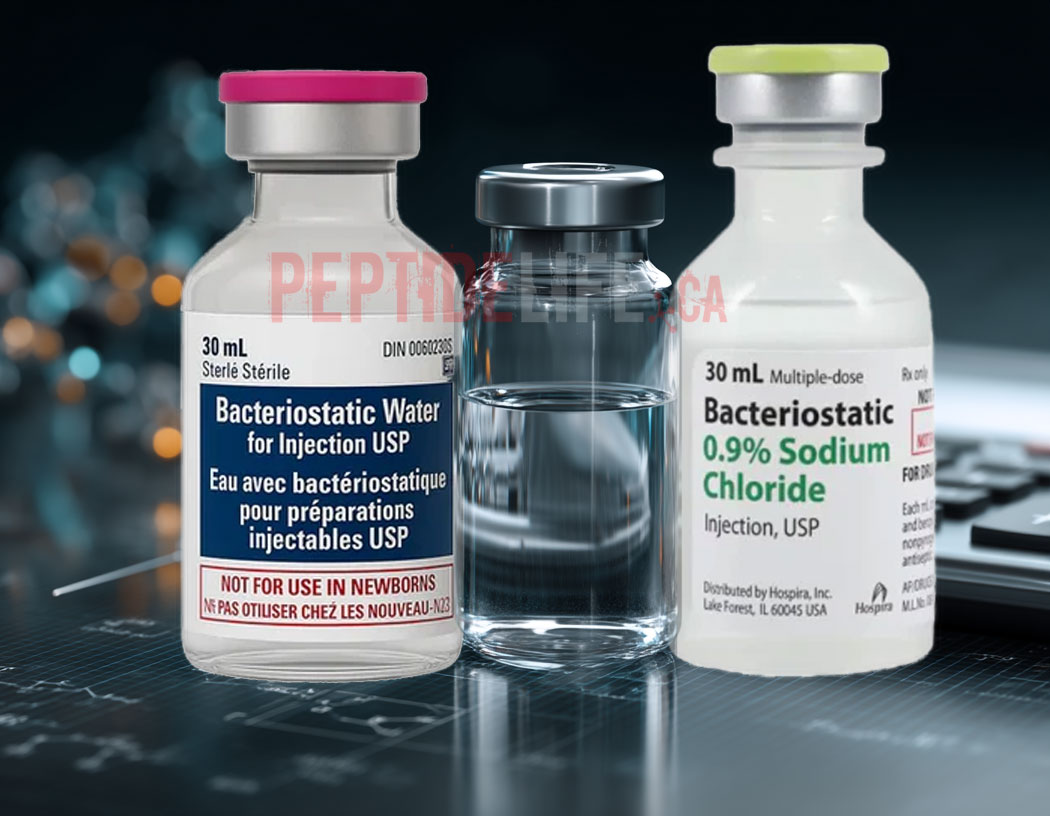
Bacteriostatic water is generally preferred over bacteriostatic saline for reconstituting lyophilized peptides, especially when the vial comes from the grey market and provides no validated information about its formulation. Both diluents commonly contain 0.9% benzyl alcohol as an antimicrobial preservative, but bacteriostatic saline also contains 0.9% sodium chloride. That added salt changes the ionic environment of the reconstituted solution and may affect how certain peptide molecules dissolve, remain separated or begin associating with one another.
This does not mean bacteriostatic saline is inherently unsafe or that it ruins every peptide. Saline can work well with some formulations and may be useful when an isotonic diluent offers a genuine advantage. However, when the vial’s peptide form, excipients, pH and stability characteristics are unknown, bacteriostatic water introduces fewer variables while providing the same common multi-dose preservative. That is the main reason it has become the more practical general-purpose choice.
In this article, the word saline refers primarily to bacteriostatic saline, officially labelled Bacteriostatic 0.9% Sodium Chloride Injection. Regular preservative-free sterile saline is a different product and is normally intended for single-dose use.
Why Bacteriostatic Water Is Usually Preferred
Bacteriostatic Water for Injection contains sterile water and commonly 0.9% benzyl alcohol. Bacteriostatic saline contains the same basic ingredients plus 0.9% sodium chloride, making it isotonic before anything else is added. Because both products usually contain the same concentration of benzyl alcohol, saline does not provide stronger antimicrobial preservation, extend peptide shelf life or make a questionable vial safer. Its defining difference is the sodium chloride.
That difference matters because grey-market peptide vials rarely provide trustworthy details about the completed formulation. The label may identify the peptide and total milligrams, but it may not disclose the peptide’s salt form, residual buffers, bulking agents, pH modifiers or other excipients left in the freeze-dried cake. Adding sodium chloride introduces another ingredient into an already uncertain mixture, whereas bacteriostatic water provides the preservative without increasing ionic strength.
Bacteriostatic water is therefore generally chosen because it has the simpler formulation, not because it has been proven perfect for every peptide. It avoids the added sodium and chloride ions that may alter solubility or promote aggregation in a susceptible compound. It also avoids the assumption that an isotonic starting diluent will automatically create a more comfortable or stable final solution. Once the peptide and its residual ingredients dissolve, the completed solution’s pH, concentration, osmolarity and injection comfort may be very different from those of the original diluent.
Once the diluent has been selected, the amount added determines the final concentration and syringe measurement. Our peptide reconstitution calculator can calculate the concentration based on the vial strength, desired dose and amount of bacteriostatic water used.
Why Saline Can Cause Clouding, Aggregation or Gel Formation
Peptide molecules interact through electrical charges, hydrogen bonding and hydrophobic regions, and the balance between those forces helps determine whether they remain separated in solution or begin associating with one another. Bacteriostatic saline contains approximately 154 millimoles per litre of sodium chloride. Those sodium and chloride ions increase ionic strength and partially screen the electrical interactions between charged regions of peptide molecules.
When similar surface charges are helping peptide molecules repel one another, increased ionic strength can reduce the effective range of that repulsion and allow the molecules to move closer together. Hydrophobic and other attractive interactions may then become more influential, potentially contributing to aggregation, precipitation, visible cloudiness, string-like material or gel formation in a susceptible formulation. It is not accurate to blame chloride ions alone: sodium ions interact more strongly around negatively charged regions, while chloride ions interact more strongly around positive regions. Together, they change the electrostatic environment surrounding the peptide.
This effect is highly molecule-specific. Sodium chloride may promote aggregation or gelation in some peptide and protein systems, have very little effect on others or occasionally improve solubility. Concentration, pH, temperature, peptide sequence, net charge, salt form and existing excipients can all change the result. That unpredictability is precisely why bacteriostatic water is generally the more sensible choice when the formulation is unknown. Saline may work perfectly well, but there is often no practical benefit to introducing additional ionic strength unless there is a known reason to do so.
Retatrutide is frequently mentioned in online reports of cloudy, stringy or gel-like solutions after reconstitution with bacteriostatic saline. There is no controlled published comparison proving that saline consistently causes genuine retatrutide to gel, but the proposed mechanism is scientifically plausible. Retatrutide is a relatively large peptide with a fatty-acid modification, and products of this type can require carefully controlled formulation conditions to remain stable. Differences in peptide purity, concentration, pH, salt form and undisclosed excipients could all contribute to the reactions users report, so clouding or gel formation cannot confirm that a vial contains genuine retatrutide or identify exactly what went wrong.
An unexpectedly cloudy, particulate, stringy or gel-like solution should not be injected or assumed to remain effective. It should not be vigorously shaken, heated or repeatedly diluted in an attempt to restore it, because those steps cannot reliably distinguish precipitation from aggregation, contamination or chemical instability. If a peptide that should normally dissolve clearly undergoes an unexpected visible change, the most cautious response is to stop using that vial.
Why Would Someone Choose Bacteriostatic Saline?
The main reason someone might choose bacteriostatic saline is isotonicity. Because it already contains 0.9% sodium chloride, saline may cause less osmotic irritation with certain medications or preparations. Some people therefore choose it when they have experienced stinging after using bacteriostatic water or when they believe an isotonic diluent will produce a more comfortable injection.
That possible benefit should not be overstated. Injection discomfort can be caused by the peptide itself, benzyl alcohol, pH, concentration, injection volume, temperature and technique. A preparation that burns after being mixed with bacteriostatic water will not necessarily become comfortable when saline is used. Saline may feel better with one compound while causing clouding or instability with another.
Bacteriostatic saline is therefore best viewed as a specialized alternative rather than an improved version of bacteriostatic water. It may be reasonable when a particular preparation is known to remain clear and perform well in saline, or when isotonicity provides a demonstrated comfort advantage. It should not be chosen because it is believed to preserve peptides longer, improve potency or provide better protection against contamination.
Before adding a larger volume of bacteriostatic water, remember that peptide vials have limited usable space. Our peptide vial capacity calculator can help estimate whether the planned amount of diluent will fit within the vial.
Bacteriostatic saline does not automatically improve stability, sterility or shelf life. In both products, benzyl alcohol helps limit bacterial growth in a repeatedly accessed vial, but it does not prevent the peptide itself from chemically degrading.
The Practical Answer
When choosing between bacteriostatic water and bacteriostatic saline for a lyophilized grey-market peptide with no validated formulation information, bacteriostatic water is generally the more practical default. It provides the same commonly used benzyl-alcohol preservation without adding sodium chloride, keeps ionic strength lower and introduces fewer variables into an uncertain formulation.
Bacteriostatic saline may offer an advantage when isotonicity genuinely improves comfort or when a particular preparation is known to behave well in sodium chloride. However, it can also contribute to clouding, precipitation, aggregation or gel formation in salt-sensitive formulations. Because that response cannot be predicted reliably from the peptide name alone, saline should not be treated as interchangeable with bacteriostatic water.
Regular sterile saline should also not be confused with bacteriostatic saline. Preservative-free sterile saline does not contain benzyl alcohol and is normally intended for single-dose use. Household saline, nasal spray, contact-lens solution, distilled water, boiled water and homemade salt water are never appropriate substitutes for a sterile injectable diluent.
The bottom line: Bacteriostatic water is usually preferred because it performs the main job of a preserved multi-dose diluent without introducing the additional sodium chloride found in saline. Saline may have specific uses, but when the peptide formulation is unknown, the simpler option generally creates fewer opportunities for salt-related instability.
Educational Disclaimer
This article is provided for general informational and educational purposes only. It does not constitute medical advice or instructions for self-administering injectable products. Grey-market peptides may have uncertain identity, purity, sterility and formulation. Consult a licensed healthcare professional or pharmacist before reconstituting or using any injectable medication or peptide.