

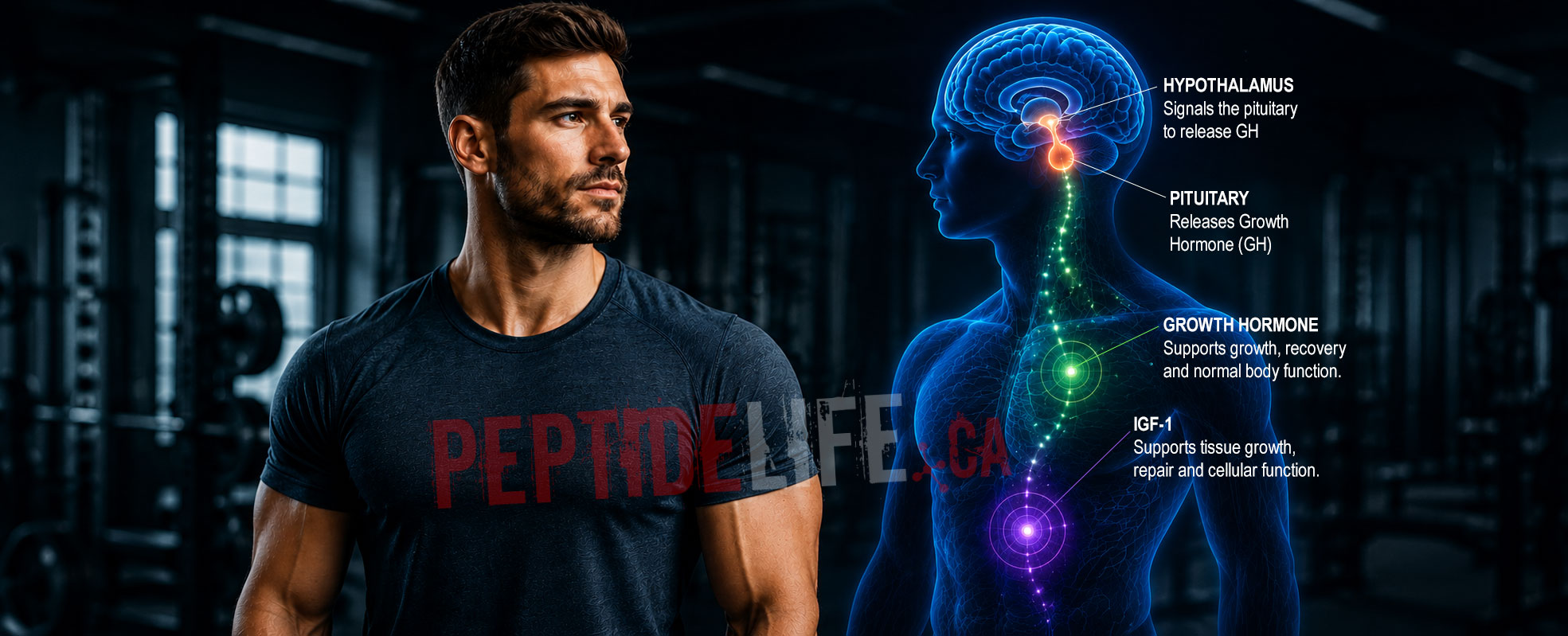
One of the most common concerns with long-term hormone use is whether the body eventually becomes dependent on it. Testosterone is a familiar example: when testosterone is supplied from outside the body, natural testosterone production can become significantly suppressed. This naturally raises a similar question about peptides. If you use peptides regularly for months at a time, does your body eventually stop producing or releasing its own hormones?
The answer depends heavily on the type of peptide being used. Peptides can work through completely different biological systems, so there is no single answer that applies to everything called a peptide. Growth hormone-releasing peptides such as CJC-1295 and Ipamorelin are particularly interesting because they work by stimulating the body’s existing growth hormone system rather than simply replacing growth hormone itself. That distinction makes them very different from something like testosterone replacement therapy.
Do Peptides Shut Down Your Natural Hormone Production?
Not necessarily. The word “peptide” describes a type of molecule, not one specific mechanism of action. Some peptides act as signalling molecules, some stimulate hormone release, some interact with specific receptors, and others influence completely different biological pathways.
Whether long-term use can suppress natural function therefore depends on what the compound actually does. A peptide that stimulates an existing hormonal pathway cannot automatically be compared with taking an external hormone that replaces something the body normally produces. This is especially relevant with growth hormone peptides because compounds such as CJC-1295 and Ipamorelin stimulate endogenous growth hormone release, meaning the growth hormone ultimately being released still comes from the person’s own pituitary gland.
Current research does not show that GH secretagogues cause the same type of persistent natural hormone shutdown associated with long-term external testosterone use. Instead, they stimulate a functioning GH system while remaining influenced by the body’s normal feedback mechanisms.
GH Peptides vs TRT: Why They Are Different
TRT provides the body with testosterone from an outside source. As circulating testosterone rises, the hypothalamus and pituitary detect those levels and reduce signalling through the hypothalamic-pituitary-gonadal axis. LH and FSH can fall substantially, which in turn reduces the testes’ natural production of testosterone.
Growth hormone-releasing peptides work differently. Instead of supplying growth hormone itself, they stimulate parts of the body’s existing GH-release system. The pituitary still has to contain and release growth hormone for these compounds to produce their intended GH response.
This is an important distinction. GH secretagogues rely on the body’s own hormone-producing machinery rather than completely bypassing it. The resulting GH release also remains influenced by normal regulatory mechanisms, including negative feedback from GH and IGF-1.
How CJC-1295 and Ipamorelin Stimulate Growth Hormone
CJC-1295 and Ipamorelin are often paired because they influence growth hormone release through different but complementary pathways. CJC-1295 is related to growth hormone-releasing hormone, or GHRH, while Ipamorelin is a growth hormone secretagogue that acts through the ghrelin receptor.
GHRH is one of the body’s natural signals telling the pituitary to produce and release growth hormone. Ghrelin and growth hormone secretagogues can also stimulate GH release through the growth hormone secretagogue receptor. These systems interact with another hormone called somatostatin, which acts as an inhibitory signal and helps regulate when growth hormone is released.
This balance contributes to the natural pulsatile pattern of growth hormone secretion. Rather than GH remaining continuously elevated throughout the day, the body normally releases it in pulses, with some of the largest occurring during sleep. Research on GH secretagogues has found that stimulated GH release can remain subject to the body’s existing negative-feedback mechanisms, which is one of the major differences between stimulating endogenous GH and simply supplying external growth hormone.
Does Your Pituitary Stop Making Growth Hormone?
There is currently no strong evidence showing that GH-releasing peptides cause the pituitary to permanently stop producing growth hormone in the way long-term testosterone use can suppress natural testosterone production. In fact, one of the reasons researchers have been interested in GH secretagogues is their ability to stimulate endogenous GH while preserving important parts of the body’s natural regulatory system.
Human research with CJC-1295 has shown that growth hormone secretion can remain pulsatile even while overall GH secretion and IGF-1 levels increase. Other research on GH secretagogues has similarly shown that they can enhance pulsatile GH secretion while remaining subject to normal negative feedback.
That does not mean the GH axis ignores higher GH or IGF-1 levels. The body still has feedback mechanisms involving GH, IGF-1, GHRH and somatostatin that help regulate how much growth hormone is released. That is normal hormonal regulation rather than evidence that the pituitary has been permanently “shut down.”
Can GH Peptides Stop Working Over Time?
This is a slightly different question from whether natural growth hormone production shuts down. Repeatedly stimulating any receptor or signalling pathway can potentially change how strongly that system responds, a process often described as desensitization or tolerance.
Growth hormone research suggests this issue is more complicated than simply saying that GH peptides eventually stop working. Some experimental studies have demonstrated reduced responsiveness under particular conditions of repeated or continuous stimulation. At the same time, human studies of GH secretagogues have demonstrated sustained increases in GH secretion or IGF-1 during continued administration.
Research with CJC-1295 is particularly interesting because repeated exposure produced sustained increases in IGF-1 while the underlying pulsatile pattern of GH secretion remained intact. Longer-term studies with other GH secretagogues have also demonstrated that the GH/IGF-1 axis can continue responding during extended treatment.
So while some degree of adaptation or reduced responsiveness is biologically possible, that is very different from saying the pituitary becomes exhausted or permanently loses its ability to release growth hormone.
What Happens When You Stop GH Peptides?
When a short-acting GH secretagogue is discontinued, its additional stimulation of GH release disappears as the compound leaves the body. IGF-1 may take longer to change because circulating IGF-1 does not rise and fall as quickly as individual GH pulses.
The body’s underlying GH system, however, is still there. The hypothalamus continues producing signals involved in growth hormone regulation, the pituitary remains responsible for producing and releasing GH, and normal feedback mechanisms continue operating. As the additional stimulation disappears, GH and IGF-1 activity can move back toward the level supported by the person’s own natural GH production.
This is consistent with the way these compounds work. They temporarily stimulate an existing hormonal system rather than replacing its output entirely. Available human research has not demonstrated the kind of persistent shutdown associated with long-term external testosterone use.
Someone may still notice a difference after stopping. If GH and IGF-1 activity were higher while using the peptides, returning toward a person’s normal baseline could potentially mean changes in sleep, recovery, fullness or other effects they noticed while using them. Returning to your normal baseline, however, is not the same thing as your body becoming unable to function without the peptide.
What About CJC-1295 With DAC vs No DAC?
The distinction between CJC-1295 with DAC and shorter-acting GHRH-type peptides is important when discussing continuous stimulation. CJC-1295 with DAC was specifically developed to remain active for a prolonged period, while shorter-acting versions commonly referred to as CJC-1295 no DAC or Modified GRF 1-29 produce much shorter periods of stimulation.
Human research on long-acting CJC-1295 found that a single injection could elevate GH for several days and IGF-1 for even longer. Multiple doses produced a cumulative effect, with elevated IGF-1 persisting beyond the immediate period following administration.
Interestingly, researchers studying long-acting CJC-1295 also found that growth hormone secretion remained pulsatile despite the prolonged stimulation. The compound increased overall GH secretion and raised trough GH levels without eliminating the underlying pulse pattern.
Shorter-acting GHRH analogues are different because their stimulation does not persist continuously for days. This is one reason short-acting GHRH peptides are frequently discussed alongside short-acting secretagogues such as Ipamorelin when the goal is to create more distinct periods of GH stimulation.
Do You Need to Cycle GH Peptides?
Cycling is extremely common in discussions surrounding peptide use, but there is not strong clinical evidence establishing one universally correct schedule for CJC-1295 and Ipamorelin. You will see protocols involving five days on and two days off, continuous daily use, several months on followed by time off, and numerous other variations.
These schedules are sometimes presented as though they have been clinically proven to prevent receptor desensitization or preserve natural growth hormone production, but the evidence is not strong enough to establish one required schedule. Taking time off does remove the additional stimulus and allows the GH/IGF-1 axis to operate without the peptide, but there is no established evidence that everyone must follow a specific cycling pattern to prevent shutdown.
Breaks can still have practical value. They allow someone to see how they feel without the additional GH stimulation and can provide an opportunity to evaluate blood markers after returning toward an untreated state. The important distinction is that choosing to cycle GH peptides and needing to cycle them because the pituitary would otherwise permanently shut down are two very different claims.
Does IGF-1 Stay Elevated After Stopping?
IGF-1 is frequently measured when evaluating activity of the growth hormone system because GH itself is difficult to assess with a single blood test. Growth hormone is released in pulses, so a random GH measurement can be very low at one moment and substantially higher later the same day. IGF-1 is considerably more stable and therefore provides a useful indirect marker of overall GH activity.
When GH-releasing peptides increase growth hormone secretion, IGF-1 can rise as a downstream effect. After the additional stimulation is discontinued, IGF-1 should move back toward the level supported by the person’s underlying GH secretion as the effects of the compound wear off.
Finding an appropriate IGF-1 level after being off GH peptides can therefore provide useful information that the GH/IGF-1 axis remains active. A single IGF-1 result cannot measure every individual GH pulse or prove that secretion is identical to what it was before peptide use, but it is a much more useful marker of overall GH activity than a random GH blood test.
What Does the Longer-Term Research Show?
The available human research on GH secretagogues is generally more reassuring than the idea of inevitable hormonal shutdown would suggest. Reviews of clinical research have found that GH secretagogues can promote pulsatile endogenous GH release that remains subject to negative feedback, and several compounds have been studied during extended administration while continuing to increase GH or IGF-1 activity.
Some longer-term studies with GH secretagogues have also investigated potential benefits involving body composition, sleep and age-related declines in GH secretion. This research is one reason endogenous GH stimulation has attracted interest as a potentially more physiological approach than simply supplying external GH.
There are still fewer rigorous long-term studies than we would ideally have, particularly for the exact CJC-1295 and Ipamorelin combinations and cycling schedules commonly discussed today. That means we cannot say that every possible protocol has been proven risk-free, but the available evidence does not support the assumption that using GH secretagogues automatically causes permanent pituitary shutdown.
Are GH Peptides More Like Stimulation Than Replacement?
This is probably the simplest way to understand the difference. TRT supplies the finished hormone from outside the body, and recombinant HGH similarly supplies growth hormone directly. GH-releasing peptides instead send signals intended to encourage the body’s existing system to release more of its own GH.
That does not make GH peptides completely immune to normal feedback or changes in receptor sensitivity. It does mean the biological situation is fundamentally different from directly replacing a hormone.
The distinction also explains why natural GH regulation still matters when using secretagogues. Sleep, age, body composition, glucose levels, insulin, somatostatin and the health of the hypothalamus and pituitary can all influence the eventual GH response. The body’s own system remains an active part of the process.
Can Your Body Become “Dependent” on GH Peptides?
The word “dependent” can mean several different things. If someone means that the pituitary permanently loses its ability to produce growth hormone simply because a GH secretagogue was used, current evidence does not show that this happens.
If “dependent” means someone becomes accustomed to the additional effects and notices a difference after stopping, that is much more plausible. If a peptide has been increasing GH and IGF-1 activity for months, removing that additional stimulation means those levels can return toward the person’s natural baseline. Someone could therefore notice changes in areas such as sleep, recovery or body composition without their body actually being incapable of producing GH.
The same distinction applies to tolerance. A reduced response to repeated stimulation is not automatically evidence of permanent hormonal shutdown, and returning to baseline after stopping something is not necessarily withdrawal or dependence. In most discussions about GH peptides, those concepts are too often treated as though they mean the same thing.
So Should Long-Term GH Peptide Users Be Worried About Shutdown?
Based on the evidence currently available, TRT-style shutdown is not something that should simply be assumed with GH-releasing peptides. Their mechanism is fundamentally different: they stimulate endogenous hormone release, rely on a functioning pituitary and remain influenced by the body’s natural feedback systems.
Research showing preserved GH pulsatility during secretagogue stimulation is particularly reassuring because it demonstrates that increasing GH activity does not necessarily eliminate the underlying natural pattern of secretion. Studies of GH secretagogues have also shown continued responsiveness during longer periods of administration rather than evidence that the pituitary simply becomes exhausted.
There are still unanswered questions about very long-term use, ideal cycling schedules and whether responsiveness changes with particular compounds or protocols. Those are reasonable areas for continued research, but they should not be confused with evidence that GH peptides inevitably cause hormonal dependence or permanent suppression.
Final Thoughts
The idea that all hormone-related compounds eventually “shut you down” comes largely from people’s familiarity with testosterone and other externally supplied hormones, but that model does not automatically apply to growth hormone-releasing peptides.
CJC-1295, Ipamorelin and other GH secretagogues work by stimulating an existing growth hormone system rather than simply replacing the hormone the pituitary would normally release. Human research has shown that GH secretagogues can increase endogenous GH secretion while retaining important aspects of natural regulation, including pulsatile secretion and negative feedback.
When that additional stimulation is removed, GH and IGF-1 activity can return toward the individual’s underlying baseline rather than leaving the body permanently dependent on the peptide. While more long-term research on modern peptide protocols would be useful, current evidence does not support treating GH-releasing peptides as though they inevitably produce the same type of shutdown associated with long-term testosterone replacement.
Understanding the difference between stimulating a hormone pathway and directly replacing a hormone is ultimately the key. They may both influence hormone levels, but biologically they are not doing the same thing.
For anyone researching GH peptides, product quality, accurate concentration and independent third-party testing are also important factors when comparing peptide sources.
Educational Disclaimer
This article is intended for educational and informational purposes only and should not be considered medical advice. Many peptides discussed for growth hormone stimulation are investigational or are not approved for general medical use. Individual responses and health considerations can vary, and anyone considering treatment that affects growth hormone, IGF-1 or other hormonal systems should discuss appropriate testing and monitoring with a qualified healthcare professional.